



Gold is one of the most debated topics in investing. Some experts love it, others turn away. Investors focus on numerous factors that drive the price of gold. One common factor is supply and demand. Another common factor is uncertainty in the markets and one that is less obvious but seems to have more predictive power over the last decade, is real yields.
Interest rates are typically quoted in nominal terms. Real yields are the yield on a security when you take inflation into account. For example, a bond with a nominal yield of 5% and inflation running at 3% would have a real yield of 2%. They have serious implications for investing, as negative real yields push investors to take on risk because an investor would not be able to receive a rate of return over inflation. .
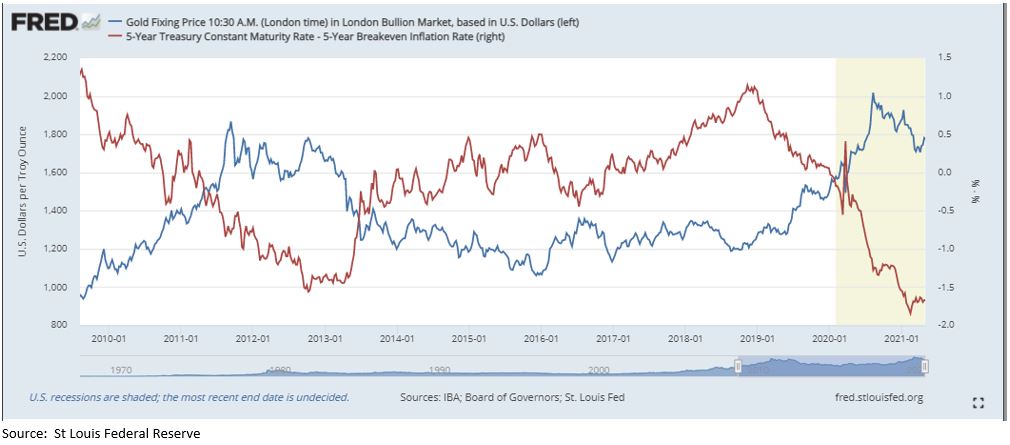
The chart above uses the 5-year treasury rate minus the 5-year breakeven inflation rate as a gauge for real yields. Based on the chart, it is evident how the price of gold moves opposite to the change in real yields. A couple of things can explain this inverse relationship. First, rising real yields point to improving economic conditions and future growth for an economy. Gold, in some areas, is viewed as a fear indicator. If economic conditions worsened, investors would be inclined to purchase gold based on those views. Second, real interest rates represent the opportunity cost to investing in anything other than interest bearing securities. Gold provides no yield. If real interest rates are rising, that makes the opportunity cost of holding gold much higher, thus suppressing the price. Importantly, the price of gold was at an elevated level when real yields were negative. The 2011 to 2012 period real yields went into negative territory, pushing the price of gold into the $1,800 range. More recently, real yields were approaching negative territory heading into the pandemic and were forced there from the global shutdown, pushing gold higher to $2,000.
It is critical to point out that the Federal Reserve has a major hand to play in real yields. The Federal Reserve has been buying treasuries on a monthly basis, while at the same time signaling to the market it will let inflation run higher for longer; in essence, creating a synthetic ceiling on nominal yields and squeezing real yields lower. Investors must be cognizant of these dynamics in overall investing, but especially when it comes to investing in gold. Nevertheless, if you are an investor that incorporates gold into your portfolio, it seems visible from the past decade that if you are able to gauge the future path of real yields it would assist in producing positive returns for gold in your portfolio.
Recent Articles
-
- Article
-
- Article
-
- Article




Helping you boost your financial intelligence.
Read our financial resources from your friends at WSFS.