

Emerging Markets: Are They Ripe for an Upswing?


With the majority of market chatter engulfed in the inflation debate, certain asset classes have been a focus for portfolios. Typically, investors flock to commodities during times of high or expected high inflation. Another asset class that can help mitigate inflation risks in a portfolio is emerging market equities. Emerging markets historically provide a buffer to high inflation and a decrease in the value of the U.S. dollar. However, the emerging markets arena has changed by geography and sector over time and investors should understand those changes before blindly investing in the space.
When a fear of higher inflation is present, or concerns surrounding government deficits devalues the currency held, investors typically seek investments that have a “store of value” quality to them. Hard assets, such as commodities, real estate, and even art, are the traditional venue for that viewpoint and prices in commodities usually surge higher.
Emerging markets also perform well during these periods. Why do emerging markets do well when the U.S. dollar drops?
One obvious reason is a dollar decrease makes most everything priced in foreign currencies move higher, including emerging market stocks. Another factor is how these countries finance their economies. Most of them borrow in U.S. dollar terms. If the U.S. dollar decreases, that will decrease their financing costs resulting in a stronger financial position. Lastly, when the U.S. dollar drops and the emerging market currencies increase, the costs of imports into these countries decreases. Decreasing import costs can strengthen the trade surplus of a country, again resulting in a stronger financial position for these countries.
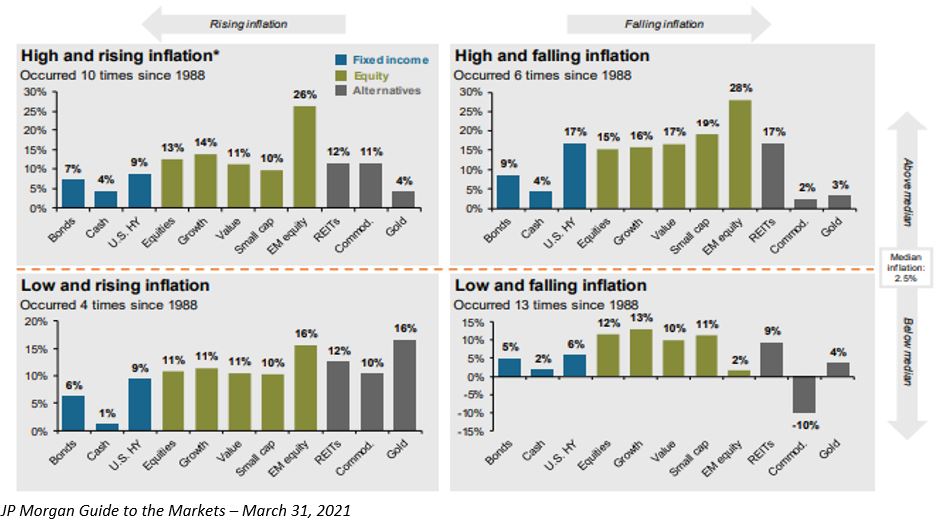
The inflation charts display how certain asset classes perform during different inflationary environments (combinations of high/low inflation and rising/falling inflation). As you can see, emerging markets perform extremely well in three out of the four periods. In fact, emerging markets outpace commodities in all four periods.
Even though the probability of a low or falling inflation environment is unlikely, there are many experts that fall on either side of the inflation argument. Thus, there is no guarantee what path inflation may take. With that in mind, generally during a low and falling inflationary environment, commodities produce negative returns. In this scenario, commodities would be a drag on a total portfolio. Even though they typically do not generate the greatest returns during period of low or falling inflation, emerging markets can still produce a small positive return, leading an investor to prefer this asset class ahead of commodities.
One caveat exists when utilizing historical figures to examine emerging market returns. Aside from the typical “past returns do not guarantee future performance,” a more specific caveat to emerging markets is how they have developed over the past 30-40 years.
Historically, emerging markets has consisted of commodity-driven economies split between Latin America and Asia. With the growth of China over the past 20 years into a global superpower, the emerging market index has shifted towards Chinese dominance and included some prominent technological, consumer discretionary companies. Companies such as Alibaba, Tencent, and Taiwan Semiconductor hold top positions inside emerging markets portfolios.
In the end, a portfolio managers due diligence is paramount when selecting an emerging markets investment to know what type of exposure you are getting by region and sector.
Recent Articles
-
- Article
-
- Article




Helping you boost your financial intelligence.
Read our financial resources from your friends at WSFS.